Growing healthy apple trees requires more than regular watering and good sunlight. Apple trees need a balanced supply of nutrients throughout the growing season to support healthy leaves, strong branches, flowering, fruit development, and overall tree health.
Choosing the best fertilizer for apple trees can therefore make an important difference in orchard management. However, there isn’t one fertilizer that works perfectly for every apple orchard.
Soil type, tree age, variety, weather, irrigation, existing nutrient levels, and crop load can all influence fertilizer requirements.
For apple growers, the goal should not simply be to apply more fertilizer. The better approach is to provide the right nutrients, in the right amount, at the right time.
This guide explains the major nutrients apple trees need, different fertilizer options, the role of NPK and micronutrients, and important factors to consider when creating a fertilizer program.
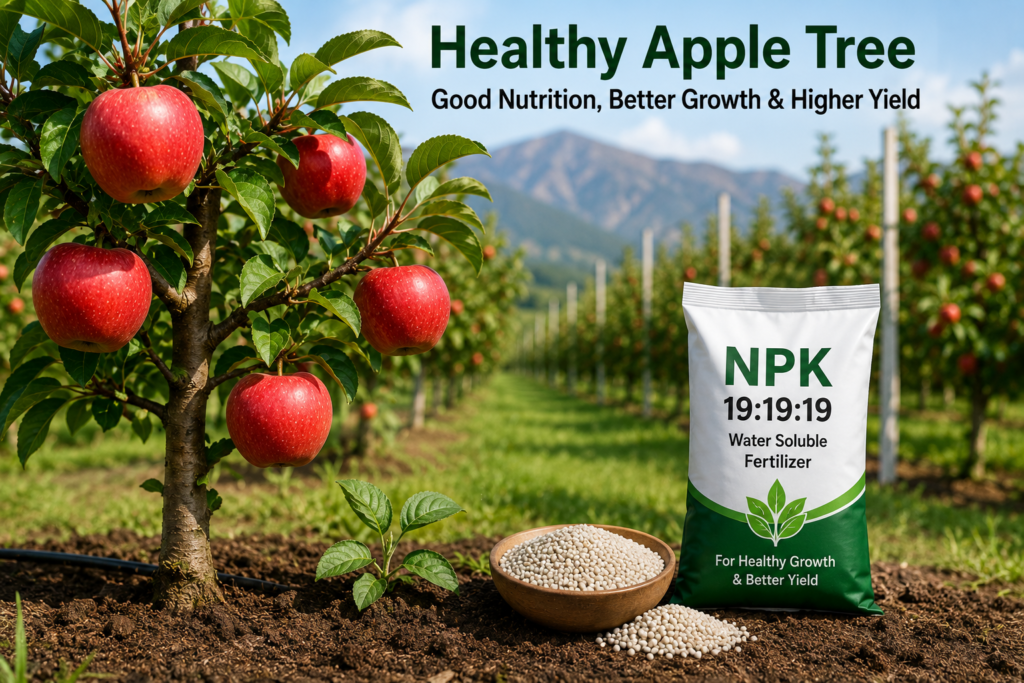
What Nutrients Do Apple Trees Need?
Apple trees require several nutrients for healthy development. These nutrients are generally divided into macronutrients and micronutrients.
Macronutrients
Apple trees require larger amounts of:
- Nitrogen (N)
- Phosphorus (P)
- Potassium (K)
- Calcium (Ca)
- Magnesium (Mg)
- Sulfur (S)
Micronutrients
These are needed in smaller quantities but still play important roles:
- Zinc (Zn)
- Boron (B)
- Iron (Fe)
- Manganese (Mn)
- Copper (Cu)
- Molybdenum (Mo)
- Nickel (Ni)
- Chlorine (Cl)
A deficiency or imbalance in any important nutrient can affect tree growth or fruit quality.
Understanding NPK Fertilizer for Apple Trees
NPK stands for Nitrogen, Phosphorus, and Potassium.
These three nutrients are commonly displayed as numbers on fertilizer packaging.
For example, an NPK fertilizer labeled 19-19-19 contains equal proportions of nitrogen, phosphorus, and potassium by weight.
However, the highest NPK number is not automatically the best choice for an apple orchard.
The correct formulation should depend on:
- Soil nutrient levels
- Tree age
- Growth stage
- Expected crop load
- Orchard management system
- Results of soil or leaf testing
Nitrogen: Supporting Vegetative Growth
Nitrogen is essential for leaf and shoot development. Healthy leaves are important because they produce energy through photosynthesis.
Adequate nitrogen can support:
- Leaf growth
- Shoot development
- Canopy formation
- Overall tree vigor
But Too Much Nitrogen Can Be a Problem
Excessive nitrogen may encourage excessive vegetative growth instead of balanced fruit production.
It can also contribute to:
- Very vigorous shoots
- Poor balance between vegetative and reproductive growth
- Delayed maturity in some situations
- Greater susceptibility to certain problems
This is why nitrogen should be managed carefully rather than applied simply to make trees grow faster.
Phosphorus: Supporting Roots and Reproductive Development
Phosphorus plays an important role in energy transfer and root development.
It contributes to:
- Root growth
- Energy metabolism
- Reproductive development
- Overall plant establishment
Apple trees generally need phosphorus in balanced amounts rather than excessive applications.
A soil test can help determine whether additional phosphorus is actually required.
Potassium: Important for Fruit Development
Potassium plays a major role in water regulation and several plant processes.
For fruit crops, adequate potassium nutrition can support:
- Fruit development
- Plant water regulation
- Overall tree vigor
- Crop quality
Because apples are harvested for their fruit, potassium management can be an important part of an orchard nutrition program.
However, excessive potassium can interfere with the uptake of other nutrients, so balance is important.
Calcium: Important for Fruit and Plant Structure
Calcium contributes to cell wall structure and plant tissue development.
In apple production, calcium management is often associated with maintaining fruit quality and reducing certain physiological disorders.
Good calcium nutrition depends not only on how much calcium is applied but also on factors such as:
- Soil conditions
- Water availability
- Root activity
- Crop load
- Nutrient balance
Magnesium: Supporting Photosynthesis
Magnesium is a central component of chlorophyll and therefore plays an important role in photosynthesis.
Healthy magnesium nutrition helps support:
- Green foliage
- Photosynthetic activity
- Energy production
- Normal plant development
Magnesium deficiency can cause yellowing between leaf veins, particularly in older leaves.
Micronutrients for Apple Trees
Macronutrients receive most of the attention, but micronutrients should not be ignored.
Two particularly important nutrients for apple production are zinc and boron.
Zinc
Zinc contributes to normal growth and several enzyme and hormone-related processes.
Low zinc availability may be associated with:
- Small leaves
- Short shoots
- Reduced growth
- Poor tree vigor
Boron
Boron plays an important role in reproductive development and is especially relevant around flowering and fruit setting.
Adequate boron nutrition can support:
- Flower development
- Pollination
- Fruit setting
- Fruit development
However, boron should be used carefully because the difference between deficiency and excessive amounts can be relatively small.
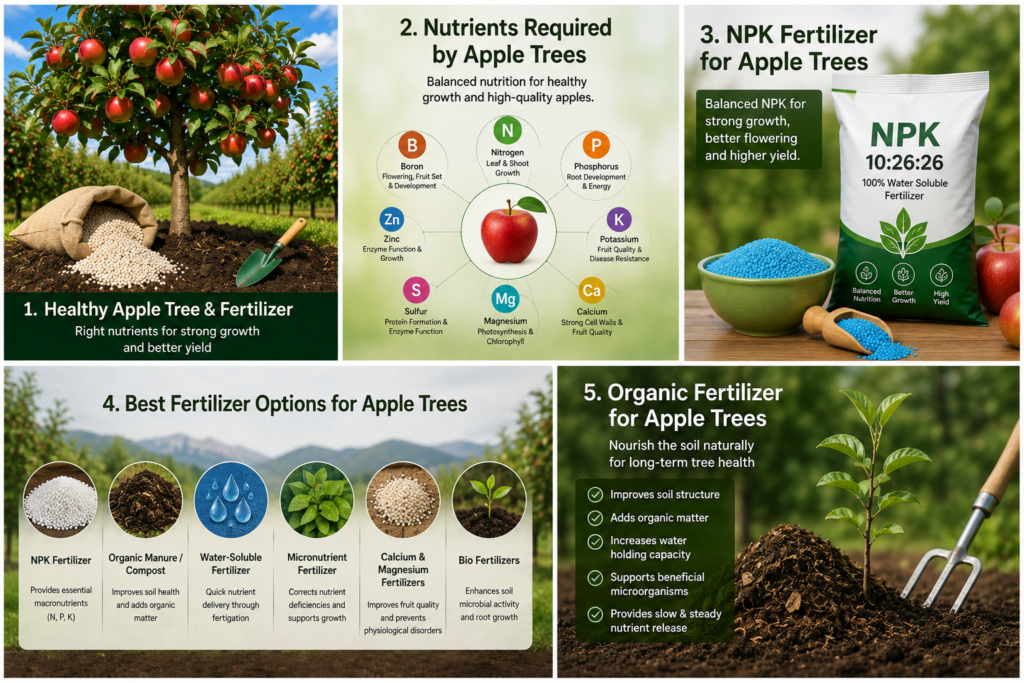
Best Fertilizer Options for Apple Trees
here isn’t one universally “best” fertilizer for every orchard.
Instead, farmers can choose from several fertilizer categories depending on their orchard conditions.
| Fertilizer Type | Main Purpose | Best Use |
|---|---|---|
| NPK Fertilizer | Provides N, P & K | General nutrient management |
| Organic Manure/Compost | Adds organic matter and nutrients | Soil improvement |
| Water-Soluble Fertilizer | Quick, controlled nutrient delivery | Fertigation |
| Micronutrient Fertilizer | Supplies trace nutrients | Correcting deficiencies |
| Calcium Fertilizer | Calcium supply | Specific nutrient management |
| Magnesium Fertilizer | Magnesium supply | Correcting magnesium deficiency |
The best choice depends on what the orchard actually needs.
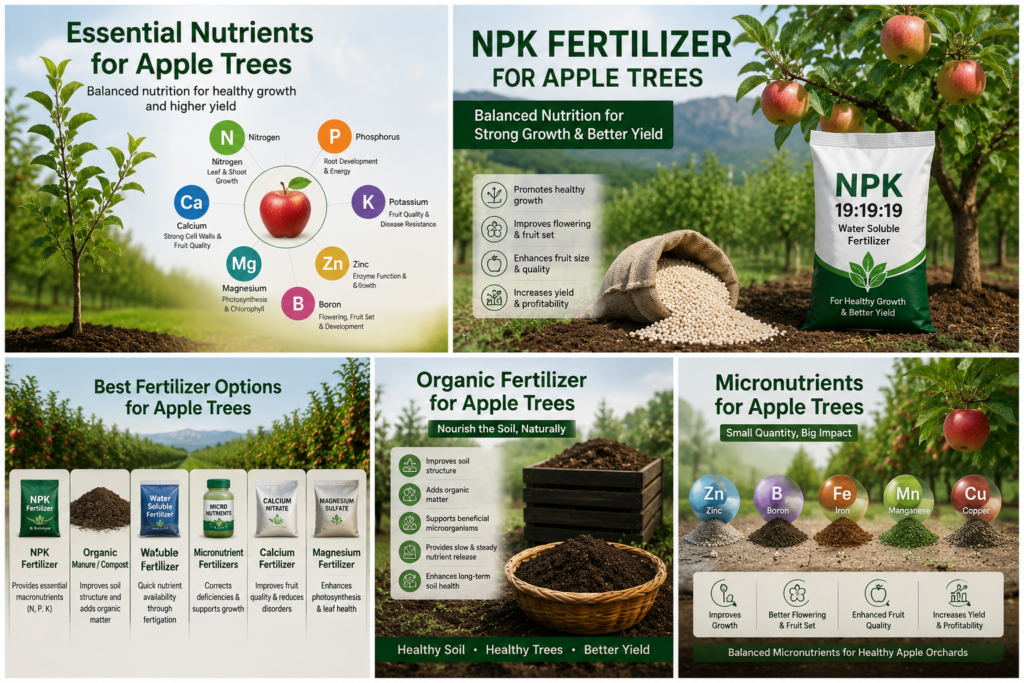
Organic Fertilizer for Apple Trees
Organic materials such as well-decomposed farmyard manure and compost can contribute organic matter and nutrients to orchard soils.
Potential Benefits
- Improves soil structure
- Adds organic matter
- Supports soil biological activity
- Contributes nutrients
- Helps maintain long-term soil health
However, organic fertilizers can vary considerably in nutrient content.
For this reason, they should not automatically be considered a complete replacement for a balanced nutrient program.
Organic Fertilizer for Apple Trees
Organic materials such as well-decomposed farmyard manure and compost can contribute organic matter and nutrients to orchard soils.
Potential Benefits
- Improves soil structure
- Adds organic matter
- Supports soil biological activity
- Contributes nutrients
- Helps maintain long-term soil health
However, organic fertilizers can vary considerably in nutrient content.
For this reason, they should not automatically be considered a complete replacement for a balanced nutrient program.
Water-Soluble Fertilizer for Apple Orchards
Water-soluble fertilizers can be useful in orchards with suitable irrigation and fertigation systems.
They allow nutrients to be delivered through irrigation water, which can make nutrient management more flexible.
Potential advantages include:
- Controlled nutrient delivery
- Convenient application through fertigation
- Useful for intensive orchard systems
- Can be combined with irrigation management
The product must be suitable for fertigation, and compatibility with the irrigation system should always be checked.
Fertilizer Requirements at Different Growth Stages
Apple trees don’t have the same nutritional requirements throughout the year. Their nutrient needs change as they move from dormancy to flowering, fruit development, and harvesting.
Instead of applying the same fertilizer throughout the season, farmers should consider the tree’s growth stage and nutrient status.
1. Early Growth Stage
During early vegetative growth, apple trees begin producing new shoots and leaves.
Nutrients such as nitrogen are important for healthy vegetative development, but excessive nitrogen should be avoided.
At this stage, farmers should focus on:
- Healthy shoot growth
- Leaf development
- Root activity
- Balanced nutrition
2. Flowering Stage
Flowering is one of the most important stages in apple production.
Good nutrition during this period supports healthy flowers and reproductive development.
Boron and zinc can be particularly important when a deficiency is present, but applications should be based on crop needs and appropriate recommendations.
Farmers should monitor:
- Flower development
- Pollination
- Flower retention
- Tree vigor
3. Fruit Setting Stage
After flowering, the tree enters the fruit-setting stage.
At this point, balanced nutrition becomes important for supporting young fruit development.
Potassium, calcium, boron, and other nutrients can play roles in fruit development, depending on the orchard’s nutrient status.
Good orchard management during this stage should combine:
- Balanced nutrition
- Proper irrigation
- Pest management
- Disease monitoring
4. Fruit Development Stage
As apples grow, the trees continue to require nutrients and adequate water.
Potassium is particularly important for several plant processes associated with fruit development and water regulation.
Calcium is also important for fruit tissue and cell-wall development.
Farmers should avoid excessive fertilizer application simply to increase fruit size. Balanced nutrition is more important than maximum fertilizer use.
Fertilizer Application Methods for Apple Trees
The best fertilizer can give poor results if it is applied incorrectly.
Apple growers can use different application methods depending on the fertilizer formulation, orchard system, soil conditions, and irrigation setup.
1. Soil Application
Soil application places nutrients into the root-zone environment where roots can take them up.
This method is commonly used for fertilizers and organic amendments that are suitable for soil application.
Tips:
- Apply according to soil-test recommendations where available.
- Keep fertilizer distribution appropriate to the active root zone.
- Avoid concentrating fertilizer directly against the trunk.
- Water appropriately after application when required.
2. Fertigation
Fertigation means supplying suitable fertilizers through irrigation water.
It can be particularly useful in orchards equipped with drip irrigation.
Benefits of Fertigation
- Allows controlled nutrient delivery
- Can distribute nutrients through the root zone
- Works with scheduled irrigation
- Can reduce the need for separate applications
However, not every fertilizer is suitable for fertigation.
Before using a fertilizer through an irrigation system, check:
- Product solubility
- Compatibility
- Irrigation equipment requirements
- Manufacturer instructions
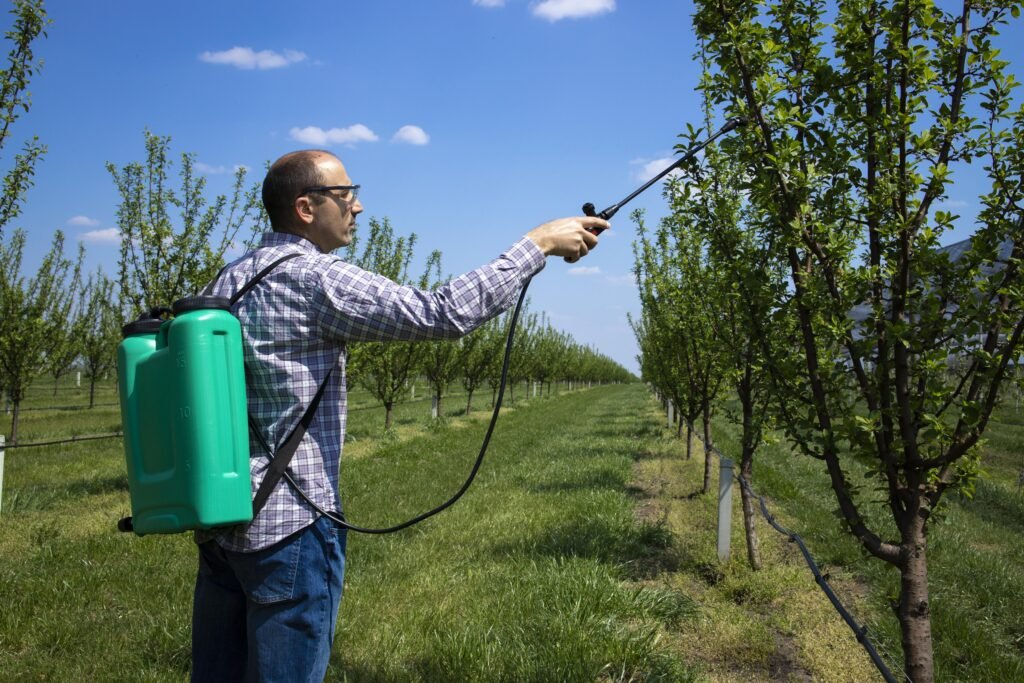
3. Foliar Application
Foliar feeding involves applying a suitable nutrient solution directly to plant leaves.
It can be useful when a specific micronutrient deficiency needs to be addressed and the product is labeled for foliar application.
Common nutrients supplied through foliar products may include:
- Zinc
- Boron
- Iron
- Manganese
Important
Foliar sprays should always be prepared according to the product label.
Using a stronger concentration does not necessarily produce better results and may cause leaf injury.
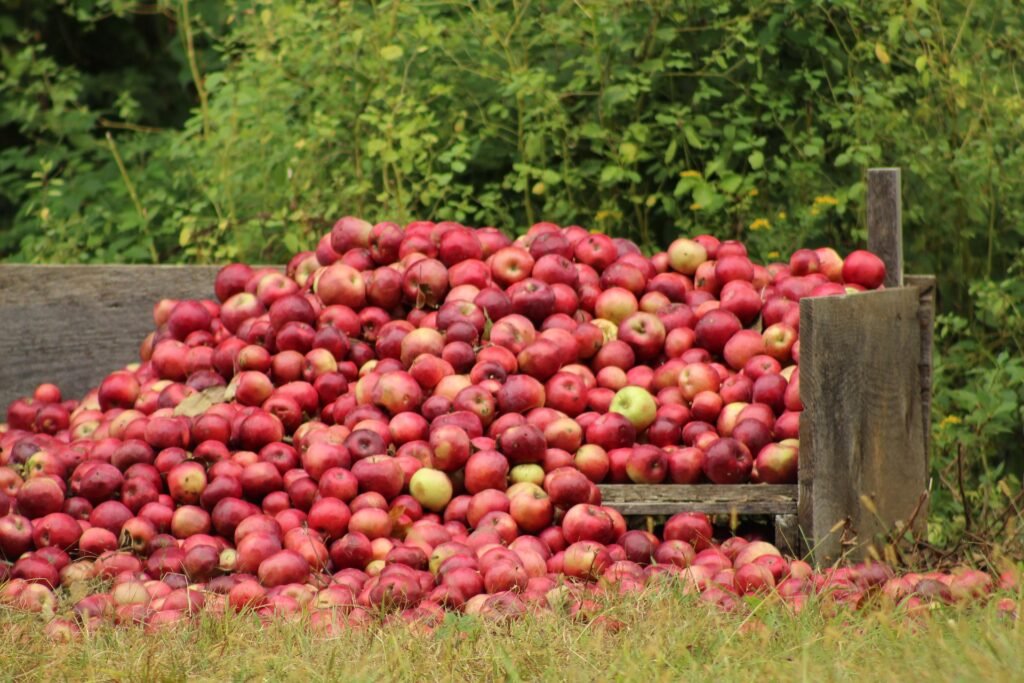
Young Apple Trees vs. Mature Apple Trees
Young Apple Trees
Young trees are primarily establishing their root systems and framework.
The focus should be on:
- Healthy root development
- Balanced vegetative growth
- Strong shoots
- Proper tree establishment
Excessive fertilizer can encourage overly vigorous growth and may not produce the desired tree structure.
Mature Apple Trees
Mature trees have larger canopies and produce fruit, so their nutrient requirements are influenced by:
- Tree size
- Crop load
- Soil fertility
- Previous year’s growth
- Expected yield
- Orchard management system
For mature orchards, fertilizer planning should ideally be based on soil and leaf analysis rather than guesswork.
Fertilizer Planning for Apple Orchards
A good fertilizer program starts before fertilizer is purchased.
Step 1: Test the Soil
Soil testing can provide information about nutrient availability and soil characteristics such as pH.
Step 2: Check Tree Performance
Look at:
- Leaf color
- Shoot growth
- Flowering
- Fruit development
- Previous year’s yield
Step 3: Identify Nutrient Problems
Don’t assume that poor growth is always caused by fertilizer deficiency.
Other factors can include:
- Poor irrigation
- Root problems
- Pest damage
- Diseases
- Soil compaction
- Weather stress
Step 4: Select the Appropriate Fertilizer
Choose a formulation based on the actual nutrient requirement.
Step 5: Monitor the Orchard
Continue observing the trees throughout the season and adjust future nutrient management based on results.
Common Fertilizing Mistakes to Avoid
Mistake 1: Applying Too Much Fertilizer
More fertilizer doesn’t automatically mean more fruit.
Excess nutrients can cause imbalances and unnecessary vegetative growth.
Mistake 2: Using the Same Fertilizer Every Year
Soil nutrient levels change over time.
A fertilizer program should be reviewed periodically rather than repeated blindly.
Mistake 3: Ignoring Micronutrients
Focusing only on NPK can overlook important nutrients such as zinc and boron.
Micronutrients are required in smaller quantities but still have important functions.
Mistake 4: Fertilizing Without Testing
Applying nutrients without knowing the soil or plant nutrient status can lead to:
- Wasted fertilizer
- Nutrient imbalance
- Unnecessary expense
- Potential environmental losses
Testing can help make fertilizer decisions more informed.
Mistake 5: Applying Fertilizer Too Close to the Trunk
Fertilizer should be distributed appropriately around the active root zone rather than piled directly against the trunk.
Always follow the product instructions.
Frequently Asked Questions About Fertilizer for Apple Trees
1. What is the best fertilizer for apple trees?
There is no single fertilizer that is best for every apple tree. The right fertilizer depends on soil condition, tree age, variety, growth stage, and nutrient requirements. A balanced fertilizer program based on soil or leaf testing is usually the best approach.
2. Which NPK is best for apple trees?
The ideal NPK ratio depends on the orchard’s nutrient status and growth stage. Instead of choosing an NPK formula based only on its numbers, farmers should consider soil testing and the tree’s specific requirements.
3. When should I fertilize apple trees?
Apple trees generally have different nutrient requirements during vegetative growth, flowering, fruit setting, and fruit development. Fertilizer timing should therefore be planned according to the tree’s growth stage and local orchard conditions.
4. Is organic fertilizer good for apple trees?
Yes. Well-decomposed organic manure and compost can add organic matter and nutrients while supporting soil structure and biological activity. However, organic materials can vary in nutrient content, so they may need to be part of a broader nutrient management program.
5. How often should apple trees be fertilized?
The frequency depends on tree age, soil fertility, fertilizer type, irrigation, crop load, and nutrient status. Rather than following the same schedule every year, farmers should review their fertilizer program based on soil and plant performance.
6. Is NPK fertilizer good for apple trees?
Yes, NPK fertilizers can provide important macronutrients—nitrogen, phosphorus, and potassium. However, the appropriate formulation and amount depend on the orchard’s actual nutrient requirements.
7. Which micronutrients are important for apple trees?
Important micronutrients include zinc, boron, iron, manganese, and copper. Zinc and boron are particularly relevant to several aspects of apple growth and reproductive development when deficiencies occur.
8. Is nitrogen fertilizer good for apple trees?
Nitrogen is essential for leaf and shoot development, but excessive nitrogen can encourage excessive vegetative growth and create nutrient imbalances. It should therefore be applied according to the tree’s requirements.
9. What fertilizer is best during apple flowering?
There isn’t one universal fertilizer for the flowering stage. Balanced nutrition is important, and nutrients such as boron and zinc may be relevant where deficiencies are identified. Exact applications should follow crop-specific recommendations and product labels.
10. How can I improve fruit size and quality in apple trees?
Good fruit development depends on more than fertilizer. Maintain balanced nutrition, adequate irrigation, appropriate crop load, good pest and disease management, and healthy soil conditions. Potassium and calcium are among the nutrients that may be important, depending on orchard nutrient status.
11. Can I use fertilizer on young apple trees?
Yes, but young trees should not simply receive the same fertilizer program as mature, fruiting trees. Their nutrition should focus on healthy establishment and balanced growth, with applications adjusted according to soil conditions and tree development.
12. Should I test soil before applying fertilizer to apple trees?
Yes, soil testing is highly recommended. It can help identify nutrient levels and soil characteristics such as pH, allowing farmers to make more informed fertilizer decisions instead of applying nutrients blindly.
Best Fertilizer for Apple Trees
Growing healthy apple trees requires more than regular watering and good sunlight. Apple trees need a balanced supply of nutrients throughout the growing season to support healthy leaves, strong branches, flowering, fruit development, and overall tree health.
Choosing the best fertilizer for apple trees can therefore make an important difference in orchard management. However, there isn’t one fertilizer that works perfectly for every apple orchard.
Soil type, tree age, variety, weather, irrigation, existing nutrient levels, and crop load can all influence fertilizer requirements.
For apple growers, the goal should not simply be to apply more fertilizer. The better approach is to provide the right nutrients, in the right amount, at the right time.
This guide explains the major nutrients apple trees need, different fertilizer options, the role of NPK and micronutrients, and important factors to consider when creating a fertilizer program.
What Nutrients Do Apple Trees Need?
Apple trees require several nutrients for healthy development. These nutrients are generally divided into macronutrients and micronutrients.
Macronutrients
Apple trees require larger amounts of:
- Nitrogen (N)
- Phosphorus (P)
- Potassium (K)
- Calcium (Ca)
- Magnesium (Mg)
- Sulfur (S)
Micronutrients
These are needed in smaller quantities but still play important roles:
- Zinc (Zn)
- Boron (B)
- Iron (Fe)
- Manganese (Mn)
- Copper (Cu)
- Molybdenum (Mo)
- Nickel (Ni)
- Chlorine (Cl)
A deficiency or imbalance in any important nutrient can affect tree growth or fruit quality.
Understanding NPK Fertilizer for Apple Trees
NPK stands for Nitrogen, Phosphorus, and Potassium.
These three nutrients are commonly displayed as numbers on fertilizer packaging.
For example, an NPK fertilizer labeled 19-19-19 contains equal proportions of nitrogen, phosphorus, and potassium by weight.
However, the highest NPK number is not automatically the best choice for an apple orchard.
The correct formulation should depend on:
- Soil nutrient levels
- Tree age
- Growth stage
- Expected crop load
- Orchard management system
- Results of soil or leaf testing
Nitrogen: Supporting Vegetative Growth
Nitrogen is essential for leaf and shoot development. Healthy leaves are important because they produce energy through photosynthesis.
Adequate nitrogen can support:
- Leaf growth
- Shoot development
- Canopy formation
- Overall tree vigor
But Too Much Nitrogen Can Be a Problem
Excessive nitrogen may encourage excessive vegetative growth instead of balanced fruit production.
It can also contribute to:
- Very vigorous shoots
- Poor balance between vegetative and reproductive growth
- Delayed maturity in some situations
- Greater susceptibility to certain problems
This is why nitrogen should be managed carefully rather than applied simply to make trees grow faster.
Phosphorus: Supporting Roots and Reproductive Development
Phosphorus plays an important role in energy transfer and root development.
It contributes to:
- Root growth
- Energy metabolism
- Reproductive development
- Overall plant establishment
Apple trees generally need phosphorus in balanced amounts rather than excessive applications.
A soil test can help determine whether additional phosphorus is actually required.
Potassium: Important for Fruit Development
Potassium plays a major role in water regulation and several plant processes.
For fruit crops, adequate potassium nutrition can support:
- Fruit development
- Plant water regulation
- Overall tree vigor
- Crop quality
Because apples are harvested for their fruit, potassium management can be an important part of an orchard nutrition program.
However, excessive potassium can interfere with the uptake of other nutrients, so balance is important.
Calcium: Important for Fruit and Plant Structure
Calcium contributes to cell wall structure and plant tissue development.
In apple production, calcium management is often associated with maintaining fruit quality and reducing certain physiological disorders.
Good calcium nutrition depends not only on how much calcium is applied but also on factors such as:
- Soil conditions
- Water availability
- Root activity
- Crop load
- Nutrient balance
Magnesium: Supporting Photosynthesis
Magnesium is a central component of chlorophyll and therefore plays an important role in photosynthesis.
Healthy magnesium nutrition helps support:
- Green foliage
- Photosynthetic activity
- Energy production
- Normal plant development
Magnesium deficiency can cause yellowing between leaf veins, particularly in older leaves.
Micronutrients for Apple Trees
Macronutrients receive most of the attention, but micronutrients should not be ignored.
Two particularly important nutrients for apple production are zinc and boron.
Zinc
Zinc contributes to normal growth and several enzyme and hormone-related processes.
Low zinc availability may be associated with:
- Small leaves
- Short shoots
- Reduced growth
- Poor tree vigor
Boron
Boron plays an important role in reproductive development and is especially relevant around flowering and fruit setting.
Adequate boron nutrition can support:
- Flower development
- Pollination
- Fruit setting
- Fruit development
However, boron should be used carefully because the difference between deficiency and excessive amounts can be relatively small.
Best Fertilizer Options for Apple Trees
here isn’t one universally “best” fertilizer for every orchard.
Instead, farmers can choose from several fertilizer categories depending on their orchard conditions.
| Fertilizer Type | Main Purpose | Best Use |
|---|---|---|
| NPK Fertilizer | Provides N, P & K | General nutrient management |
| Organic Manure/Compost | Adds organic matter and nutrients | Soil improvement |
| Water-Soluble Fertilizer | Quick, controlled nutrient delivery | Fertigation |
| Micronutrient Fertilizer | Supplies trace nutrients | Correcting deficiencies |
| Calcium Fertilizer | Calcium supply | Specific nutrient management |
| Magnesium Fertilizer | Magnesium supply | Correcting magnesium deficiency |
The best choice depends on what the orchard actually needs.
Organic Fertilizer for Apple Trees
Organic materials such as well-decomposed farmyard manure and compost can contribute organic matter and nutrients to orchard soils.
Potential Benefits
- Improves soil structure
- Adds organic matter
- Supports soil biological activity
- Contributes nutrients
- Helps maintain long-term soil health
However, organic fertilizers can vary considerably in nutrient content.
For this reason, they should not automatically be considered a complete replacement for a balanced nutrient program.
Organic Fertilizer for Apple Trees
Organic materials such as well-decomposed farmyard manure and compost can contribute organic matter and nutrients to orchard soils.
Potential Benefits
- Improves soil structure
- Adds organic matter
- Supports soil biological activity
- Contributes nutrients
- Helps maintain long-term soil health
However, organic fertilizers can vary considerably in nutrient content.
For this reason, they should not automatically be considered a complete replacement for a balanced nutrient program.
Water-Soluble Fertilizer for Apple Orchards
Water-soluble fertilizers can be useful in orchards with suitable irrigation and fertigation systems.
They allow nutrients to be delivered through irrigation water, which can make nutrient management more flexible.
Potential advantages include:
- Controlled nutrient delivery
- Convenient application through fertigation
- Useful for intensive orchard systems
- Can be combined with irrigation management
The product must be suitable for fertigation, and compatibility with the irrigation system should always be checked.
Fertilizer Requirements at Different Growth Stages
Apple trees don’t have the same nutritional requirements throughout the year. Their nutrient needs change as they move from dormancy to flowering, fruit development, and harvesting.
Instead of applying the same fertilizer throughout the season, farmers should consider the tree’s growth stage and nutrient status.
1. Early Growth Stage
During early vegetative growth, apple trees begin producing new shoots and leaves.
Nutrients such as nitrogen are important for healthy vegetative development, but excessive nitrogen should be avoided.
At this stage, farmers should focus on:
- Healthy shoot growth
- Leaf development
- Root activity
- Balanced nutrition
2. Flowering Stage
Flowering is one of the most important stages in apple production.
Good nutrition during this period supports healthy flowers and reproductive development.
Boron and zinc can be particularly important when a deficiency is present, but applications should be based on crop needs and appropriate recommendations.
Farmers should monitor:
- Flower development
- Pollination
- Flower retention
- Tree vigor
3. Fruit Setting Stage
After flowering, the tree enters the fruit-setting stage.
At this point, balanced nutrition becomes important for supporting young fruit development.
Potassium, calcium, boron, and other nutrients can play roles in fruit development, depending on the orchard’s nutrient status.
Good orchard management during this stage should combine:
- Balanced nutrition
- Proper irrigation
- Pest management
- Disease monitoring
4. Fruit Development Stage
As apples grow, the trees continue to require nutrients and adequate water.
Potassium is particularly important for several plant processes associated with fruit development and water regulation.
Calcium is also important for fruit tissue and cell-wall development.
Farmers should avoid excessive fertilizer application simply to increase fruit size. Balanced nutrition is more important than maximum fertilizer use.
Fertilizer Application Methods for Apple Trees
The best fertilizer can give poor results if it is applied incorrectly.
Apple growers can use different application methods depending on the fertilizer formulation, orchard system, soil conditions, and irrigation setup.
1. Soil Application
Soil application places nutrients into the root-zone environment where roots can take them up.
This method is commonly used for fertilizers and organic amendments that are suitable for soil application.
Tips:
- Apply according to soil-test recommendations where available.
- Keep fertilizer distribution appropriate to the active root zone.
- Avoid concentrating fertilizer directly against the trunk.
- Water appropriately after application when required.
2. Fertigation
Fertigation means supplying suitable fertilizers through irrigation water.
It can be particularly useful in orchards equipped with drip irrigation.
Benefits of Fertigation
- Allows controlled nutrient delivery
- Can distribute nutrients through the root zone
- Works with scheduled irrigation
- Can reduce the need for separate applications
However, not every fertilizer is suitable for fertigation.
Before using a fertilizer through an irrigation system, check:
- Product solubility
- Compatibility
- Irrigation equipment requirements
- Manufacturer instructions
3. Foliar Application
Foliar feeding involves applying a suitable nutrient solution directly to plant leaves.
It can be useful when a specific micronutrient deficiency needs to be addressed and the product is labeled for foliar application.
Common nutrients supplied through foliar products may include:
- Zinc
- Boron
- Iron
- Manganese
Important
Foliar sprays should always be prepared according to the product label.
Using a stronger concentration does not necessarily produce better results and may cause leaf injury.
Young Apple Trees vs. Mature Apple Trees
Young Apple Trees
Young trees are primarily establishing their root systems and framework.
The focus should be on:
- Healthy root development
- Balanced vegetative growth
- Strong shoots
- Proper tree establishment
Excessive fertilizer can encourage overly vigorous growth and may not produce the desired tree structure.
Mature Apple Trees
Mature trees have larger canopies and produce fruit, so their nutrient requirements are influenced by:
- Tree size
- Crop load
- Soil fertility
- Previous year’s growth
- Expected yield
- Orchard management system
For mature orchards, fertilizer planning should ideally be based on soil and leaf analysis rather than guesswork.
Fertilizer Planning for Apple Orchards
A good fertilizer program starts before fertilizer is purchased.
Step 1: Test the Soil
Soil testing can provide information about nutrient availability and soil characteristics such as pH.
Step 2: Check Tree Performance
Look at:
- Leaf color
- Shoot growth
- Flowering
- Fruit development
- Previous year’s yield
Step 3: Identify Nutrient Problems
Don’t assume that poor growth is always caused by fertilizer deficiency.
Other factors can include:
- Poor irrigation
- Root problems
- Pest damage
- Diseases
- Soil compaction
- Weather stress
Step 4: Select the Appropriate Fertilizer
Choose a formulation based on the actual nutrient requirement.
Step 5: Monitor the Orchard
Continue observing the trees throughout the season and adjust future nutrient management based on results.
Common Fertilizing Mistakes to Avoid
Mistake 1: Applying Too Much Fertilizer
More fertilizer doesn’t automatically mean more fruit.
Excess nutrients can cause imbalances and unnecessary vegetative growth.
Mistake 2: Using the Same Fertilizer Every Year
Soil nutrient levels change over time.
A fertilizer program should be reviewed periodically rather than repeated blindly.
Mistake 3: Ignoring Micronutrients
Focusing only on NPK can overlook important nutrients such as zinc and boron.
Micronutrients are required in smaller quantities but still have important functions.
Mistake 4: Fertilizing Without Testing
Applying nutrients without knowing the soil or plant nutrient status can lead to:
- Wasted fertilizer
- Nutrient imbalance
- Unnecessary expense
- Potential environmental losses
Testing can help make fertilizer decisions more informed.
Mistake 5: Applying Fertilizer Too Close to the Trunk
Fertilizer should be distributed appropriately around the active root zone rather than piled directly against the trunk.
Always follow the product instructions.
Frequently Asked Questions About Fertilizer for Apple Trees
1. What is the best fertilizer for apple trees?
There is no single fertilizer that is best for every apple tree. The right fertilizer depends on soil condition, tree age, variety, growth stage, and nutrient requirements. A balanced fertilizer program based on soil or leaf testing is usually the best approach.
2. Which NPK is best for apple trees?
The ideal NPK ratio depends on the orchard’s nutrient status and growth stage. Instead of choosing an NPK formula based only on its numbers, farmers should consider soil testing and the tree’s specific requirements.
3. When should I fertilize apple trees?
Apple trees generally have different nutrient requirements during vegetative growth, flowering, fruit setting, and fruit development. Fertilizer timing should therefore be planned according to the tree’s growth stage and local orchard conditions.
4. Is organic fertilizer good for apple trees?
Yes. Well-decomposed organic manure and compost can add organic matter and nutrients while supporting soil structure and biological activity. However, organic materials can vary in nutrient content, so they may need to be part of a broader nutrient management program.
5. How often should apple trees be fertilized?
The frequency depends on tree age, soil fertility, fertilizer type, irrigation, crop load, and nutrient status. Rather than following the same schedule every year, farmers should review their fertilizer program based on soil and plant performance.
6. Is NPK fertilizer good for apple trees?
Yes, NPK fertilizers can provide important macronutrients—nitrogen, phosphorus, and potassium. However, the appropriate formulation and amount depend on the orchard’s actual nutrient requirements.
7. Which micronutrients are important for apple trees?
Important micronutrients include zinc, boron, iron, manganese, and copper. Zinc and boron are particularly relevant to several aspects of apple growth and reproductive development when deficiencies occur.
8. Is nitrogen fertilizer good for apple trees?
Nitrogen is essential for leaf and shoot development, but excessive nitrogen can encourage excessive vegetative growth and create nutrient imbalances. It should therefore be applied according to the tree’s requirements.
9. What fertilizer is best during apple flowering?
There isn’t one universal fertilizer for the flowering stage. Balanced nutrition is important, and nutrients such as boron and zinc may be relevant where deficiencies are identified. Exact applications should follow crop-specific recommendations and product labels.
10. How can I improve fruit size and quality in apple trees?
Good fruit development depends on more than fertilizer. Maintain balanced nutrition, adequate irrigation, appropriate crop load, good pest and disease management, and healthy soil conditions. Potassium and calcium are among the nutrients that may be important, depending on orchard nutrient status.
11. Can I use fertilizer on young apple trees?
Yes, but young trees should not simply receive the same fertilizer program as mature, fruiting trees. Their nutrition should focus on healthy establishment and balanced growth, with applications adjusted according to soil conditions and tree development.
12. Should I test soil before applying fertilizer to apple trees?
Yes, soil testing is highly recommended. It can help identify nutrient levels and soil characteristics such as pH, allowing farmers to make more informed fertilizer decisions instead of applying nutrients blindly.